I · A plural field of perception
The world exceeds a human sensory window
Human beings do not encounter the world without limits. We select, organise and interpret portions of it through bodies, habits, language, instruments and shared concepts. Sensory ecology gives a practical name to this point: different organisms inhabit different perceptual worlds because their sensory capacities are tuned to different ecological problems.[1] A bird oriented through magnetic cues, an insect responding to odour plumes, and a person reading language on a screen do not thereby occupy separate universes. They encounter different, useful aspects of one shared physical environment.
This is a reason for intellectual humility, not for abandoning observation. A wider range of measurements can correct a narrow human impression. It may reveal a chemical trace, a field, a pattern of movement, or a risk that unaided senses miss. But an instrument always has a response function, a calibration range, noise, a failure mode and a context of use. It gives a reading; it does not settle the final ontology of what is real.
Instruments expand the evidence available to a community. They do not dissolve the community's responsibility to interpret, test, and decide what to do.
The practical task is to make our partial view more corrigible. We can compare signals from different instruments, invite independent replication, retain anomalies rather than smoothing them away, and state where a model stops applying. In this sense, measurement helps humans capture and connect a sub-reality: a bounded, purpose-shaped model of a larger reality we share. Its value lies in accountable use and revision, not in a claim to final possession.
II · Quantum precision, not mystical access
Quantum sensing changes sensitivity, not causality
Quantum sensors use controllable quantum properties to make highly sensitive measurements of time, fields, acceleration, gravity, temperature or other quantities. Their importance is technical: they can improve precision and open new measurement regimes in carefully designed experiments.[2] This challenges a simple picture in which observation is only a blunt, mechanical registration of externally fixed objects. It does not remove the need for reproducibility, local apparatus, calibration or causal explanation.
Nor does quantum entanglement make an instrument a channel for usable faster-than-light communication, remote mind-reading or access to a hidden universal consciousness. Bell-test research establishes strong non-classical correlations; it does not supply a device for sending controllable messages faster than light.[3] The scientifically responsible conclusion is narrower and more useful: the physical means of measurement can be richer than everyday classical intuition suggests, while claims about what an experiment proves must remain proportionate to the experiment.
III · Biological signals in technical systems
A living sensor is not a disposable metaphor
Biohybrid work makes the question concrete. Research groups have coupled biological sensory structures with electronics and robots—for example, using moth antennae as odour sensors to guide a drone towards an odour source.[4] Earlier work at the University of Washington likewise demonstrated a small drone using a live moth antenna as its chemical detector.[5] Such projects are not evidence that a drone shares an insect's experience. They show that a biological structure can transduce a signal in ways engineers may find useful.
That distinction matters ethically. We should not romanticise other species as morally pure alternatives to humanity, nor dismiss them as mere industrial components. Lions, pigeons, dogs, horses and other animals have evolved different forms of social coordination, care, competition learning and harm under distinct ecological conditions. Human descriptions such as “loyal,” “cruel,” or “obedient” are often value-laden translations of behaviour across a species boundary. Human practices—including pest control, farming, companion-animal training, service work and sport—already show how contingent and conflicted our own ethics can be.
This ambiguity is not an excuse for indifference. It is a reason to make the burden of proof stronger. Where living organisms, tissues or sensory structures are used, researchers and institutions should ask what can be replaced, reduced or refined; the 3Rs provide a recognised framework for doing so.[8] Ethics in biohybrid robotics additionally requires attention to welfare uncertainty, purpose limitation, governance and public legitimacy—not just technical performance.[7]
IV · AI as a translator among partial views
Fusion should make uncertainty more visible
An AI system can align time-stamped signals from cameras, chemical detectors, satellite feeds, weather stations, laboratory instruments and human reports. It can look for patterns that no single observer can follow continuously. That creates a powerful collective instrument: not a single omniscient eye, but a model that joins heterogeneous traces under explicit assumptions.
Signal
What was detected, by which sensor, where and when?
Model
What transformation, training data and assumption connected the signals?
Claim
What probability or explanation does the system offer—and what remains uncertain?
Decision
Who decides whether the claim is relevant to a public action, and who can contest it?
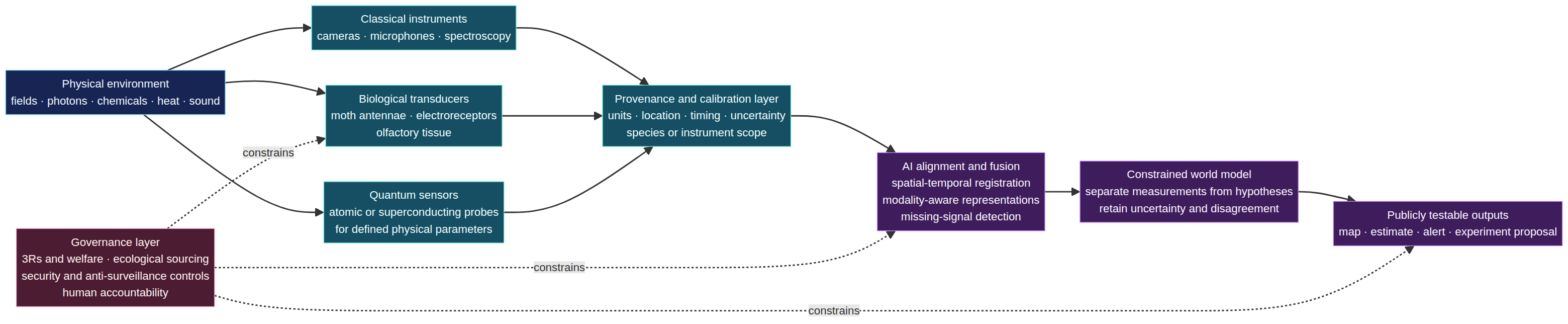
The failure to avoid is a quiet collapse of these four stages. A system may be accurate at a narrow classification yet unsuitable for a consequential decision; a confident prediction may depend on a missing population, a shifted environment, or a hidden objective. NIST's AI Risk Management Framework similarly treats governance, mapping, measurement and management as continuing functions rather than a one-time technical test.[6] Provenance, calibration, uncertainty and an appeal path are not bureaucratic decoration. They are how a shared model remains open to correction.
V · Prediction is not welfare
A good forecast cannot choose the good
Here lies the central political boundary. An AI can estimate the likelihood of an event under given inputs and objectives. It may forecast demand, identify correlations, optimise a route or detect a medical anomaly. It cannot, by statistical confidence alone, determine whose welfare should count, what sacrifice is fair, which risks are acceptable, or what kind of relationship a society should have with living beings.
Human welfare is not a hidden number waiting to be extracted from data. It is a contested public practice formed through experience, sensitivity, imagination, dialogue and institutions. People can learn from predictions, but they must still define goals, disclose trade-offs, hear those adversely affected and revise a decision when evidence or values demand it. This does not make measurement subjective or useless. It gives measurement its proper role: an input to accountable collective judgement.
The more capable the prediction, the more important it becomes to distinguish what the model estimates from what a community is entitled to choose.
VI · A governance compact
Build capability with boundaries that can answer back
Responsible life-sciences guidance stresses risk assessment, oversight and a culture of responsibility where biological knowledge can be misapplied.[10] For biohybrid sensing, that broad principle can be made operational through five visible rules:
- 1
Name the biological input
Document the organism, tissue or sensory structure, the collection conditions, and the uncertainty in what the signal represents.
- 2
Separate signal from welfare
A measured response may improve a device without showing that the organism is unaffected. Welfare assessment must be a distinct decision path.
- 3
Use the least burdensome viable method
Apply replacement, reduction and refinement before scaling a living component merely because it is commercially convenient.
- 4
Keep the model contestable
Record provenance, calibration, error rates and dissenting interpretations so an AI-fused output can be audited and challenged.
- 5
Reserve public judgement
Predictions can inform choices, but institutions must make welfare goals, trade-offs, appeal and remedy visible to the people affected.
These rules do not make every application acceptable. They make disagreement legible before a system is normalised at industrial scale. In a field that joins living materials, electronics, data and public infrastructure, the right question is never only “can it work?” It is also “what does it cost, who bears it, what would change our minds, and who retains the right to say no?”
Closing proposition
An expanded sensorium calls for expanded responsibility
Humanity can become more aware of its own partial perspective by learning from other sensory capacities and by building better instruments. That is a promising form of progress. The promise is lost if expanded detection becomes a licence for domination, if an AI summary becomes an unchallengeable authority, or if a welfare choice is renamed an objective output. The durable achievement is not a final view from nowhere. It is a better shared practice of observing, questioning, caring and correcting.
Continue the Decalogy dialogue
Related readings
Constrained Agency
A separate September 2026 essay on adaptation, hierarchy and the conditions for meaningful human alternatives.
Read the essayThe Seeded Perception
A dialogue Part on projection, trained perception and the limits of instruments that claim to improve what people see.
Read Part CVBiological Minds to Mechanical Companions
A public reflection on mechanical intelligence, material limits and accountable delegation.
Read the essaySources and further reading
Evidence, not borrowed authority
The interpretation and normative framework are the Decalogy's. These sources support the specific scientific, technical and governance context used here; they do not demonstrate the essay's broader philosophical conclusions by themselves.
- 1
Perceptual Worlds and Sensory Ecology — Nature Education / Scitable
- 2
Quantum Sensors — National Institute of Standards and Technology
- 3
The Nobel Prize in Physics 2022: Popular information — Nobel Prize Outreach
- 4
Insect antennae as biosensors in bio-hybrid odor-guided drones — Communications Engineering, 2025
- 5
Smellicopter: a bio-hybrid drone using a live moth antenna — University of Washington
- 6
AI Risk Management Framework — National Institute of Standards and Technology
- 7
Ethics and responsibility in biohybrid robotics research — Frontiers in Robotics and AI
- 8
- 9
Directive 2010/63/EU on the protection of animals used for scientific purposes — European Union
- 10
Global guidance framework for the responsible use of the life sciences — World Health Organization
- 11
Animal Culture and Social Learning — Convention on Migratory Species