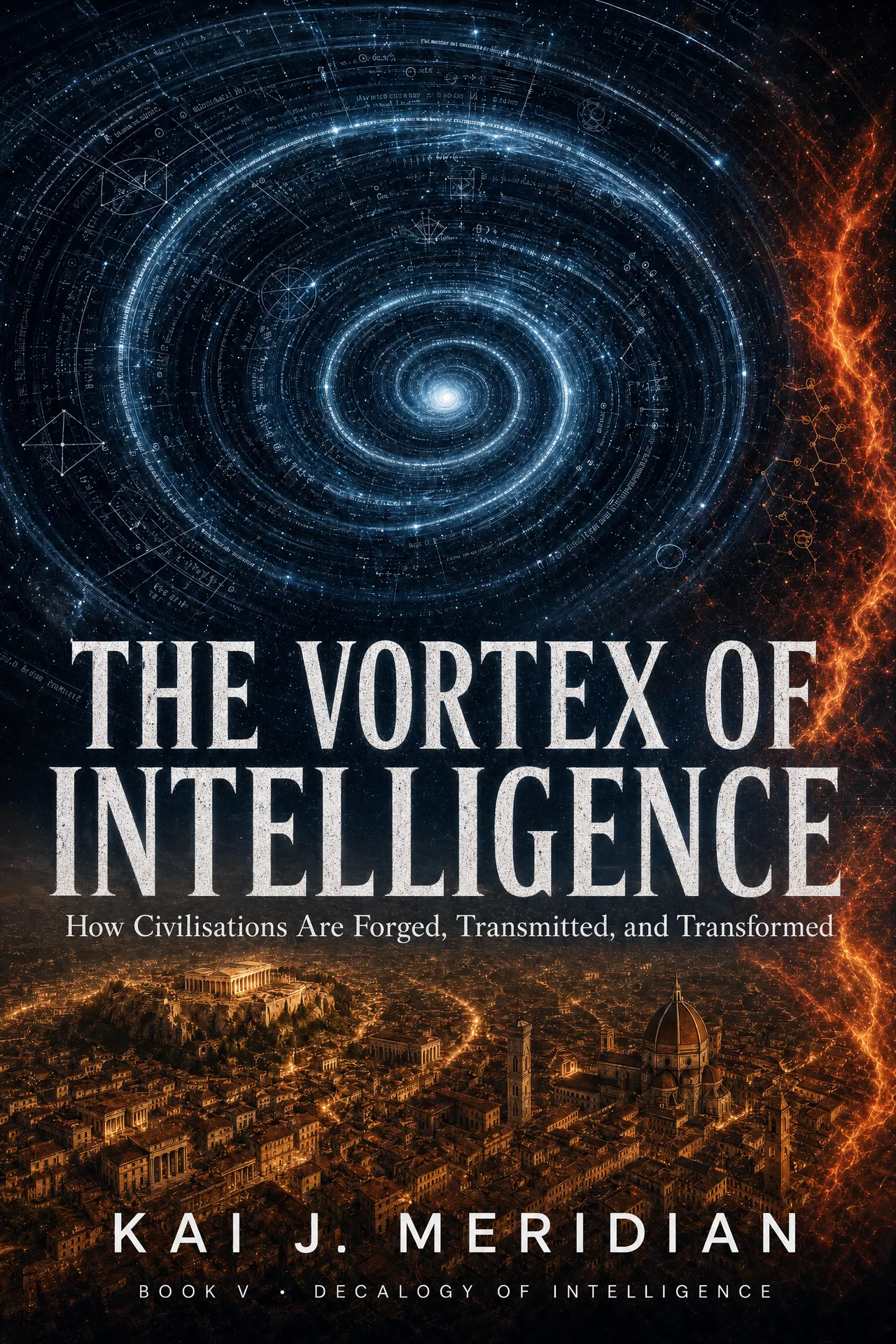
The Vortex of Intelligence
How Civilisations Are Forged, Transmitted, and Transformed
by Kai J. Meridian · ASIN: B0H6221MVX
Why do some civilisations flourish while others collapse? Why do some eras produce extraordinary concentrations of genius, while others produce stagnation and decline? The Vortex of Intelligence answers these questions with a unified framework grounded in thermodynamics, complexity theory, and evolutionary biology.
Through the vortex hypothesis — the proposition that intelligence is the universe's primary ordering activity — Meridian reveals the mechanisms by which civilisations are forged, the individuals who serve as their catalysts, and the specific dynamics that characterise the current substrate transition.
Core Concepts
The universal self-organising dynamic through which intelligence builds structures of increasing complexity against entropy — from stellar nucleosynthesis to civilisational development.
An environment of concentrated pressure — geographic, social, or intellectual — that converts adversity into capability by forcing the development of new cognitive and institutional forms.
The collective intelligence that emerges from dense knowledge networks — the distributed cognitive system that exceeds the sum of its individual members.
The pivotal individual who concentrates the forging pressures of their era, synthesises the knowledge of their time, and transmits that synthesis to the next phase of civilisational development.
The structural lag between the rate of technological change and the rate of institutional adaptation — the primary source of civilisational crisis during substrate transitions.
The civilisational trajectory that becomes possible when the substrate transition is navigated constructively — a civilisation that can harness stellar energy and provide material abundance for every human being.
Book Structure
Part I: The Physics of Civilisation
Chapter 1
The Prime Vortex
Intelligence as the universe's primary ordering activity — the self-reinforcing cycle that drives development from the Big Bang to the twenty-first century.
Chapter 2
The Forging Zones
The specific environments where civilisational pressure converts adversity into capability: the desert, the frontier, the siege, the exile.
Chapter 3
Density and the Big Mind
How urban density creates the conditions for collective intelligence that exceeds the sum of its individual members.
Part II: The Architects of the Vortex
Chapter 4
The Pivotal Individual
The Transmission Node profile: the specific configuration of forging pressure, knowledge synthesis, and transmission capacity that defines the pivotal individual.
Chapter 5
The City as the Knowledge Attractor
Why cities are not merely places where people live but the primary instruments through which civilisation builds its collective intelligence.
Chapter 6
The Innovation Cluster
The geography of breakthrough: why Silicon Valley, Renaissance Florence, and Golden Age Athens share a common structural logic.
Part III: The Crisis of Transition
Chapter 7
The Reification of Destruction
How the institutions that once enabled civilisational development become the primary obstacles to the next phase of development.
Chapter 8
The Adaptation Gap
Why the rate of institutional change always lags the rate of technological change — and what happens when the gap becomes too large.
Chapter 9
The Substrate Transition
The most consequential event in the history of intelligence since the emergence of the human brain: the migration of intelligence from biological to mechanical substrate.
Part IV: The Constructive Future
Chapter 10
The AI SELF
The first individually-calibrated instrument for closing the adaptation gap within a single lifetime — not a replacement for human intelligence but its most powerful amplifier.
Chapter 11
The Formation Network
The civilisational infrastructure of the substrate transition: the global network of institutions, communities, and relationships that can support the development of Transmission Nodes at scale.
Chapter 12
The Abundance Horizon
The choice at the edge of the vortex: between the terrestrial scarcity paradigm and the stellar abundance paradigm that the substrate transition makes possible.
Case Studies: Five Transmission Nodes
| Node | Era | Primary Synthesis | Vortex Impact |
|---|---|---|---|
| 🌿 Charles Darwin | 1830–1882 | Natural selection | Biological framework |
| ⚛️ Marie Curie | 1890–1934 | Radioactivity | Nuclear age |
| ⚙️ James Watt | 1763–1800 | Steam engine | Industrial Revolution |
| 💡 Steve Jobs | 1976–2011 | Human interface | Digital democratisation |
| 🚀 Elon Musk | 2002–present | Reusable space launch | Multi-planetary civilisation |