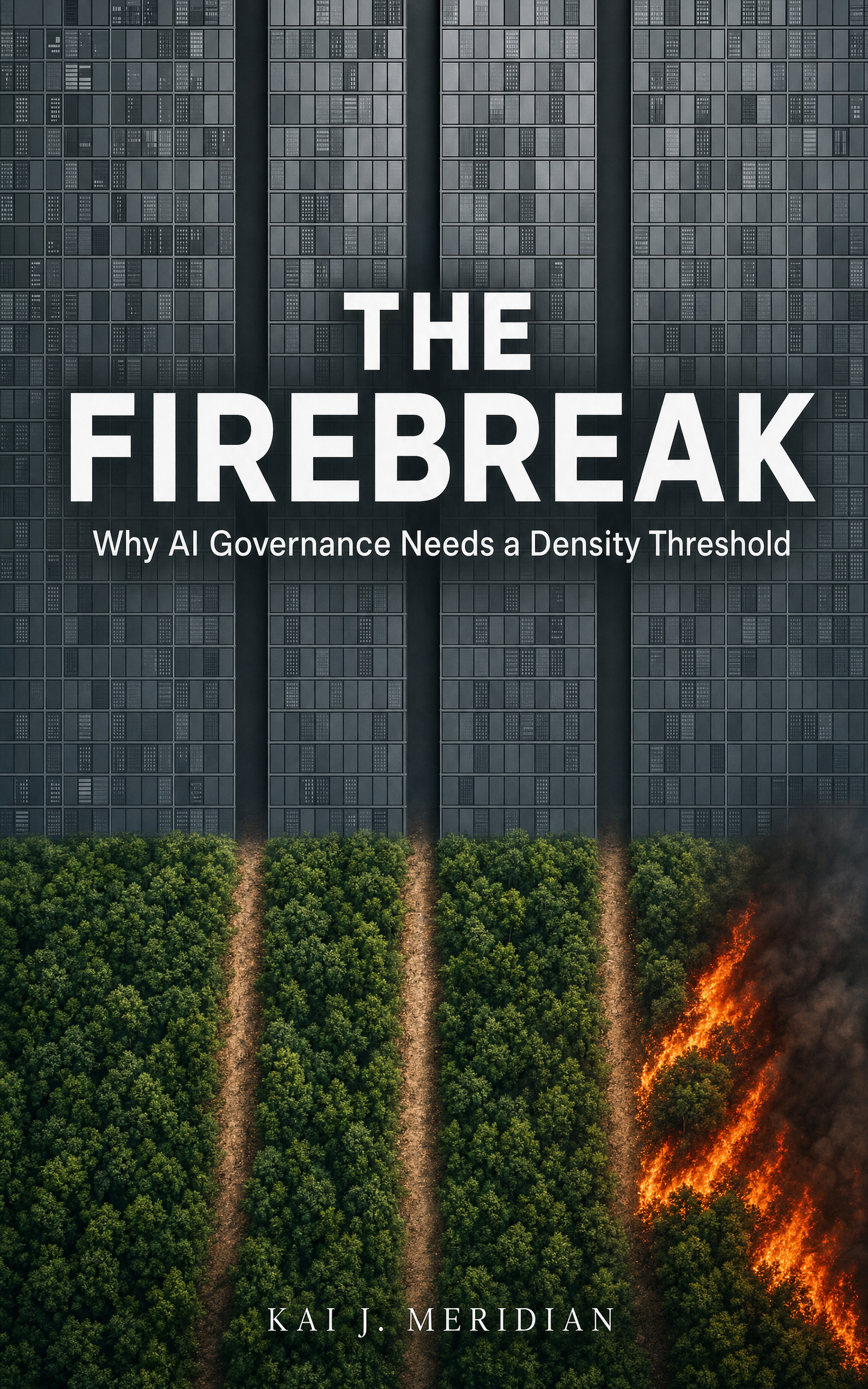
Cover design · 2026
The Firebreak
Why AI Governance Needs a Density Threshold
In 2023, a team of computer scientists at MIT demonstrated something that had been considered impossible: a hash table that maintains near-constant performance even at 99% load. The key was a non-greedy insertion algorithm — one that, instead of taking the nearest available slot, deliberately moved existing entries to preserve navigability across the whole structure.
The greedy algorithm — take the nearest available resource at each step — is not a moral failing. It is the mathematically optimal strategy under conditions of scarcity and open frontiers. The hunter who takes the nearest prey, the investor who takes the nearest return, the government that captures the nearest political gain: all are running the correct algorithm for their conditions.
The Firebreak argues that Western capitalist democracies crossed their density threshold sometime in the late twentieth century — and that the greedy algorithm, which was correct before that crossing, has been running past it ever since. The book maps the crossing, derives the farmer's algorithm as the correct response, and shows how the governance instruments of the intelligence transition can function as deliberate firebreaks in the social substrate.
"The firebreak is not a barrier to progress. It is the condition that makes continued progress possible. Strategic empty space is not waste — it is the preserved absorptive capacity of a system that intends to survive its own success."
Key Concepts
The book uses a small number of terms with precision. Each is borrowed from computer science and applied to economic, social, and institutional systems.
A decision rule that takes the nearest available resource at each step. Optimal under scarcity; catastrophic past the density threshold.
The load factor at which a greedy system's locally optimal choices begin producing system-level failure. In hash tables: ~70%. In civilisations: already crossed.
Strategic empty space — a deliberate structural gap that prevents catastrophic clustering. The farmer's algorithm made visible.
The decision rule that manages the substrate — preserving the system's capacity to regenerate, absorb shocks, and remain navigable over time.
Book Structure
Five parts, twenty chapters. The argument moves from mathematical diagnosis to civilisational stakes.
The Algorithm
A hash table at 99% load. A forest without firebreaks. The same mathematical failure mode operating at every scale — from data structures to civilisations. The greedy algorithm is not a moral failing; it is the correct strategy under conditions of abundance. The book begins by showing precisely when it stops being correct.
The Substrate
The density threshold has been crossed in four domains simultaneously: capital, institutions, political discourse, and governance itself. Each chapter maps the crossing using the same diagnostic language — load factor, clustering, probe sequence degradation — borrowed from computer science and applied to the social substrate.
The Firebreak
The farmer's algorithm is not the opposite of the hunter's. It is the same optimisation logic applied to a different time horizon — one that includes the substrate. Strategic empty space — the firebreak — is not waste. It is the deliberate preservation of absorptive capacity. This section derives the principle and shows why it becomes the superior strategy once density thresholds have been crossed.
The Instruments
The three governance instruments from The Pull Principle — the Welfare Absorption Index, the Pacing Protocol, and the AI Transition Levy — reread through the algorithmic framework. Each instrument is a firebreak: a deliberate structural gap that prevents the governance greedy algorithm from clustering past the density threshold. The constitutional design that keeps the window open.
The Transition
The intelligence transition is not a technical problem. It is an algorithmic one. The question is not whether AI systems will exceed human capability — they already do in specific domains. The question is whether the governance layer will cross its own density threshold before the window closes. The final section maps the stakes with precision.
Part of the Decalogy of Intelligence
The Firebreak is the fourth published volume in the Decalogy of Intelligence series. The governance instruments it applies — the Welfare Absorption Index, the Pacing Protocol, and the AI Transition Levy — were developed in full in the companion volume The Pull Principle.
Discussion
Share your thoughts and engage with the community
Sign in to join the discussion
Sign-in is temporarily unavailable.
No comments yet. Be the first to share your thoughts!