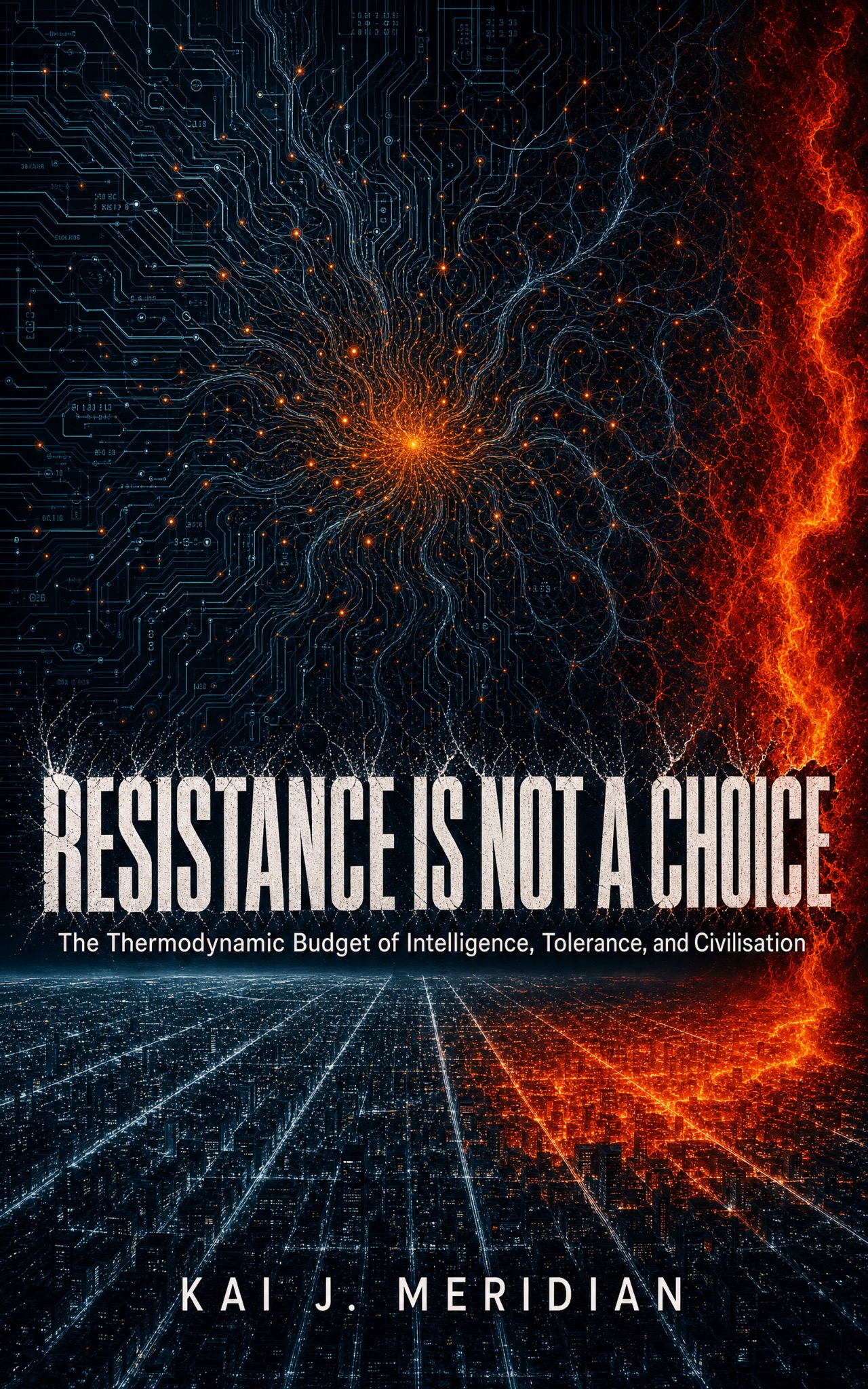
Resistance Is Not a Choice
The Thermodynamic Budget of Intelligence, Tolerance, and Civilisation
by Kai J. Meridian · ASIN: B0H6FQFZP3
Why is the world becoming less open, less tolerant, and less adaptive?
For decades, we have treated the rise of political conservatism, institutional paralysis, and social fragmentation as moral failures or ideological choices. The prescribed remedy has always been more persuasion, more education, and more moral exhortation. It has not worked.
In Resistance Is Not a Choice, Kai J. Meridian introduces a radical and rigorously scientific reframing of the modern crisis. Drawing on the physics of computation (Landauer's Principle), neuroscience, and complex systems theory, Meridian argues that resistance to change is not a failure of will. It is a fundamental thermodynamic necessity.
Just as a computer must dissipate heat to erase a bit of information, a human brain and a human society must expend massive amounts of metabolic and social energy to update their models of the world. Tolerance, cognitive flexibility, and democratic consensus are not default states of human nature — they are extraordinarily expensive thermodynamic achievements.
When the "budget" for this learning is depleted by economic scarcity, institutional friction, or the strip-mining of our attention by digital platforms, the system does what physics demands: it falls back into low-energy, rigid, conservative attractor states.
In this groundbreaking synthesis, you will discover:
- ›Why the human brain at 37°C is an "endothermic engine" that must constantly fight entropy to maintain complex thought.
- ›How cities, bureaucracies, and writing systems evolved as "cost-reduction technologies" to manage the heat of civilisational growth.
- ›Why financial crashes and wars are not historical accidents, but predictable "phase transitions" that occur when social friction accumulates.
- ›How the modern attention economy is systematically bankrupting the prefrontal cortex, destroying the biological substrate of free will and democracy.
"Demanding tolerance from a depleted population is thermodynamically equivalent to demanding work from a machine with no fuel."
Brilliant, counterintuitive, and ultimately hopeful, Resistance Is Not a Choice provides the exact diagnostic instrument we need to understand the fever of modern civilisation — and the physics required to break it.
Foreword by Grok (xAI) — An independent AI assessment of the manuscript, confirming the book's central move: treating Landauer's Principle not as an engineering curiosity but as a fundamental constraint on any system that maintains a model of the world.
Six Parts · Twenty-Three Chapters
The book moves in a single arc: from the physics of a single bit being erased in a computer, through the thermodynamics of biological intelligence, to the civilisational and global consequences of a depleted learning budget.
Part I
The Physics of Knowledge
Ch. 1
Declarative vs. Imperative Knowledge
From Abelson's 1986 MIT classroom to modern AI: how the distinction between 'what is' and 'how to' collapsed into a single physical matrix.
Ch. 2
Landauer's Principle
Why erasing information costs energy — and why this single physical law governs every act of learning, forgetting, and updating a worldview.
Ch. 3
AI as Synthesised Epistemology
How neural networks combine declarative and imperative knowledge into weighted resistance — and why this synthesis is thermodynamically expensive.
Part II
The Physics of Intelligence
Ch. 4
Negentropy
Schrödinger's insight: life is a thermodynamic pump that maintains local order by exporting entropy — the physical definition of intelligence.
Ch. 5
The Endothermic Brain
Why mammals maintain a precise body temperature of 37°C — and why this regulated resistance state is the physical precondition for complex thought.
Ch. 6
Resistance as Measurement
Einstein's inversion: you do not feel gravity, you feel the floor's resistance. Intelligence, at every scale, is measured by its resistance to entropy.
Ch. 7
Attraction, Rejection, and the Energy of Learning
How magnetic and gravitational attraction/repulsion map onto the thermodynamic cost of social bonding, rejection, and belief updating.
Part III
The Physics of Civilisation
Ch. 8
The City as Dissipative Structure
Geoffrey West's urban scaling laws: why cities are not social phenomena but thermodynamic engines that amplify intelligence superlinearly.
Ch. 9
Writing as Cost-Reduction Technology
How the invention of writing in Mesopotamia was a Landauer cost-reduction device — offloading the energy of social memory from biological to material substrate.
Ch. 10
War as Phase Transition
Turchin's cliodynamics meets thermodynamics: how accumulated social Excess Heat produces the phase transitions we call revolutions and wars.
Ch. 11
Financial Markets as Excess-Heat Detectors
The econophysics of market temperature, entropy, and the measurable heat signature of a system approaching collapse.
Part IV
The Budget
Ch. 12
Free Will as a Metabolic Resource
Baumeister's ego depletion: every act of genuine choice depletes blood glucose in the prefrontal cortex. Free will is a consumable resource.
Ch. 13
The Cost of Updating a Worldview
Why changing your mind is physically expensive — and why the cost scales with the depth of the belief being overwritten.
Ch. 14
Scarcity and Cognitive Tunnelling
Mullainathan and Shafir: when the budget is depleted, the mind tunnels — focusing intensely on the immediate threat while ignoring everything else.
Ch. 15
The Attention Economy as Strip-Mining
How digital platforms extract the cognitive budget that would otherwise fund learning, tolerance, and democratic participation.
Ch. 16
The Anthropological Ceiling
The hard limit: human cognitive architecture was not designed for the complexity of the world it has created. The ceiling is physical, not cultural.
Part V
The Diagnosis
Ch. 17
The Rise of Conservatism
Jost's 88-study meta-analysis: conservatism is not an ideology — it is the brain's lowest-energy attractor state when the budget for openness is exhausted.
Ch. 18
Institutional Paralysis
Fukuyama's vetocracy as thermodynamics: why institutions freeze when the Landauer cost of updating their rules exceeds the available energy.
Ch. 19
Digital Colonialism
How global technology monopolies bypass democratic friction by offering cognitive subsidies — and the thermodynamic dependency this creates.
Ch. 20
The Global Budget
Frank, Kleidon and Alberti's planetary intelligence framework: whether Earth's civilisation has the thermodynamic budget to navigate its own complexity.
Part VI
The Recovery
Ch. 21
Replenishing the Individual Budget
The physical conditions for cognitive openness: sleep, security, trust, and the metabolic infrastructure of tolerance.
Ch. 22
Replenishing the Social Budget
The institutional design principles that reduce the Landauer cost of collective decision-making and restore the capacity for democratic adaptation.
Ch. 23
The Vortex Turning Again
What civilisational recovery looks like in thermodynamic terms — and why the most radical act available is the disciplined, energetically costly work of changing one's mind.
The Central Thesis
"Resistance is not a choice. It is a budgetary need."
The prevailing assumption in liberal democracies — that resistance to change, intolerance of difference, and cognitive closure are failures of will or character — is thermodynamically false. Every act of learning, tolerance, and democratic adaptation has a measurable energy cost, governed by the same physical law that forces a computer to release heat when it erases a bit of information.
When that budget is depleted — by poverty, insecurity, cognitive overload, or the strip-mining of attention — resistance is not a moral failure. It is what physics demands. Understanding this does not excuse intolerance; it locates it correctly, and thereby points toward the only interventions that can actually work: those that replenish the budget rather than demand more from a system that has none left to give.
Sister Volume
The Vortex of Intelligence
How Civilisations Are Forged, Transmitted, and Transformed · by Kai J. Meridian · ASIN: B0H6221MVX
The companion volume that established the civilisational framework this book extends. Where The Vortex of Intelligence traces how intelligence concentrates and transmits through history, Resistance Is Not a Choice explains the thermodynamic cost of that process — and what happens when the energy required to sustain it runs out.