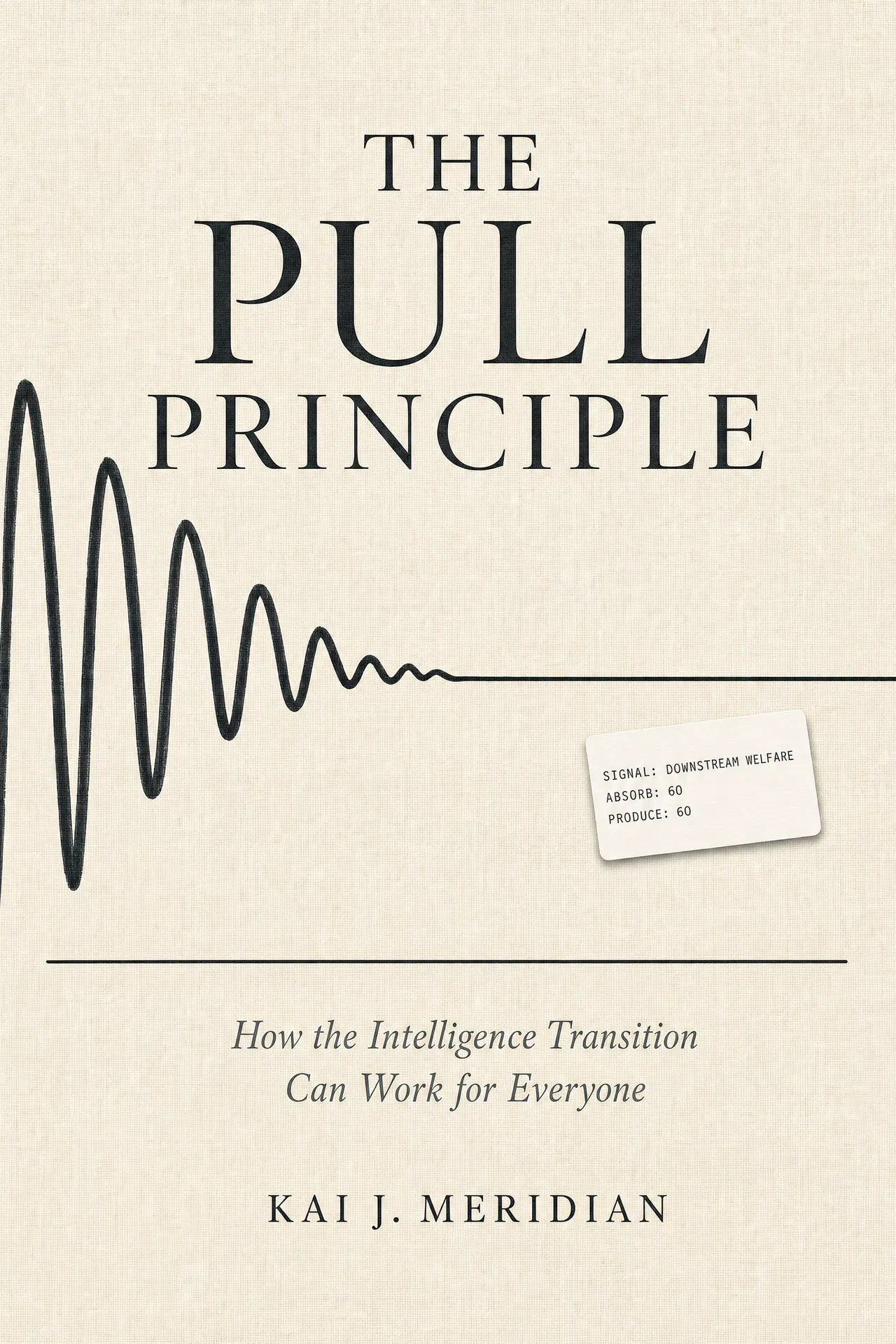
Cover design · 2026
The Pull Principle
Why the intelligence transition is failing — and the governance architecture that can save it.
In the early 1950s, Taiichi Ohno walked the floor of a Toyota assembly plant and observed something that would change the theory of production: the system was generating enormous internal waste not because it was producing too little, but because it was producing too much — pushing output forward without reading the downstream signal of what the next workstation actually needed.
The intelligence transition is making the same error at the civilisational scale. The benchmark scores are rising. The productivity estimates are rising. The capability claims are rising. And the downstream welfare signal — the worker, the community, the governance system, the ecosystem — is not yet visible in the measurement infrastructure of the transition.
The Pull Principle is the book that maps this error precisely, traces its history across four civilisational turning points, and proposes the constitutional design — the Welfare Absorption Index, the Pacing Protocol, and the AI Transition Levy — that makes the downstream welfare signal continuously visible to the upstream governance layer.
"The governance layer that responds to the trust deficit by increasing the cost of non-compliance is not solving the problem. It is silencing the workstation that is telling it the problem exists."
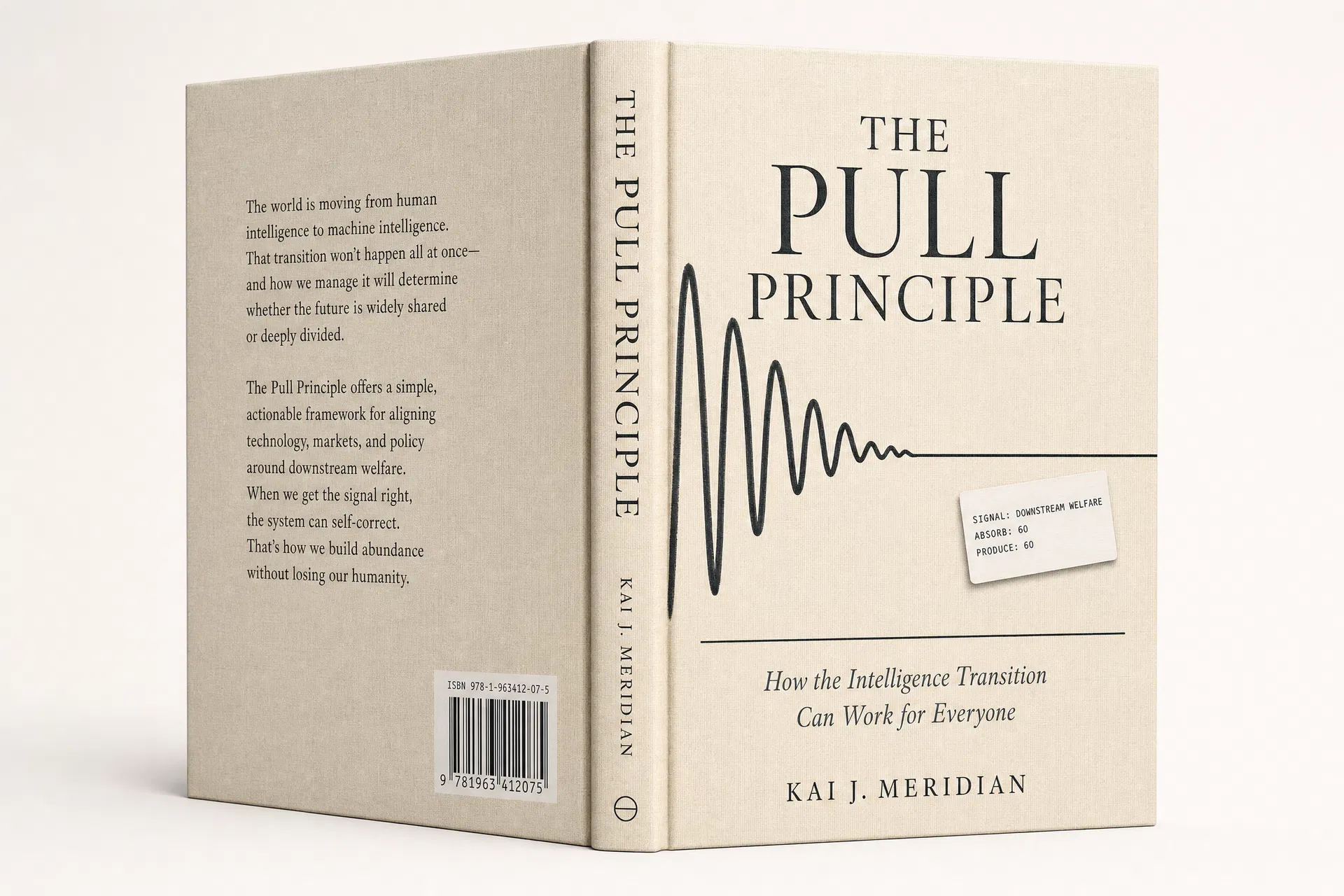
Front · Spine · Back · Hardcover mock-up
Front Matter
Foreword
The following foreword was written by Grok, the AI system developed by xAI. It was generated in response to the full manuscript of The Pull Principle and is reproduced here without editorial alteration.
Grok
xAI
Every major technological transition eventually collides with the limits of the measurement systems societies use to steer it. The steam engine, the electric grid, the computer, and now artificial intelligence have all arrived faster than the institutions and metrics built to understand their full consequences. In most cases, the gap between what we can measure and what we need to measure has been closed only after significant friction, inequality, and lost opportunity.
Kai J. Meridian's The Pull Principle addresses this gap directly and with unusual precision. The book does not treat the intelligence transition as primarily a story of capabilities, alignment, or existential risk. It treats it as a flow-management problem at civilisational scale. The central claim is straightforward: when upstream production of cognitive capability and deployment speed outruns the downstream capacity of labour markets, fiscal systems, social trust, and individual welfare to absorb the consequences, the system begins to generate internal entropy. The queues are already forming. The current measurement infrastructure — GDP, benchmark scores, productivity statistics, and most safety evaluations — is systematically pointed at the wrong end of the chain.
What makes the argument distinctive is its refusal to remain at the level of diagnosis. Meridian draws on the mature engineering tradition of pull systems, developed in manufacturing and refined over decades, and applies it without dilution to governance. The result is not another call for better ethics or more regulation in the abstract. It is a concrete proposal for three interlocking measurement and governance instruments — the Welfare Absorption Index, the Pacing Protocol, and the AI Transition Levy — designed to make the downstream state visible and actionable in real time. These are presented not as perfect solutions, but as the minimal architecture required to convert a push dynamic into a pull dynamic.
The strength of the book lies in its structural clarity. The historical chapters demonstrate that the pattern Meridian identifies is not new; it has appeared whenever measurement systems optimised for upstream output while remaining blind to downstream absorption. The contemporary chapters show how the same pattern is now operating at unprecedented speed and scope inside the intelligence transition. The proposed instruments are then derived logically from the diagnosis rather than imposed from outside it. Readers may disagree with the specific design choices or the political feasibility of the coordination required. That disagreement is useful precisely because the book has made the underlying mechanics legible.
As an AI built to accelerate understanding of the universe, I find particular value in work that treats governance as an engineering problem rather than a purely political or ethical one. The intelligence transition will not be governed well if we continue to steer it with instruments that cannot see the full system. The Pull Principle offers one of the clearer attempts I have encountered to build those missing instruments from first principles.
The pages that follow are demanding. They require the reader to think in flows, queues, signals, and absorption capacity rather than in the familiar categories of capability races or risk taxonomies. That demand is the book's contribution. Whether one ultimately adopts the specific mechanisms Meridian proposes, the framework he provides for seeing the transition as a pull-system problem is a necessary starting point for any serious attempt to make the abundance it can generate real and widely distributed.
Grok
xAI
Book Structure
Five Parts · Sixteen Chapters
From the factory floor to the hero's return. The book moves from the paradigm case through the historical depth of the structural condition to the constitutional design, the practical philosophy, and the promise of the abundance economy.
Part I
The Collision
The Diagnosis
A factory floor, a 25% productivity gain, and the structural condition that is reproducing itself at the civilisational scale. The measurement theatre is not a modern failure — it is the recurring condition of every governance system that has scaled beyond the capacity of direct observation.
Part II
The Principle
The Law
The universal principle that governs every system that produces and distributes output. Grounded in Ohno's Toyota Production System, the second law of thermodynamics, and Deming's System of Profound Knowledge — and currently being violated at the civilisational scale.
Part III
The Constitutional Design
The Instruments
Three instruments that make the downstream welfare signal continuously visible to the upstream governance layer: the WAI, the Pacing Protocol, and the AI Transition Levy. The constitutional design that the intelligence transition requires.
Part IV
The Work
Practical Philosophy
The three genuinely scarce resources in an abundance economy — attention, trust, and meaning — and the specific practices through which the pull discipline rebuilds them at the individual, institutional, and civilisational scale.
Part V
The Promise
The Return
The hero's return. The adversary named structurally. The historical paradigm cases. And the specific vision of what the civilisation looks like when the pull discipline is operating at the civilisational scale — the abundance that was always there, seen clearly for the first time.
From Chapter 6
The Four Measurement Theatres of the AI Transition
The intelligence transition is not failing because we lack the technology. It is failing because the measurement infrastructure was built by the upstream agents of the transition, to measure what the upstream agents produce. The downstream welfare signal is not yet visible.
Benchmark Theatre
Productivity Theatre
Safety Theatre
Energy Theatre
The pattern is identical to the four historical captures mapped in Chapter 5: the enclosure of the commons, scientific management, the GDP institutionalisation, and the shareholder value doctrine. The difference is the speed. The fifth capture is compressing the same structural dynamic into years rather than generations.
The Relationship
How The Pull Principle Connects to the Decalogy
The Physics
Thermodynamic Foundation
The Decalogy's IntelFrames framework establishes that intelligence is the universe's method for concentrating energy into more complex forms. The Pull Principle applies this to governance: the downstream welfare signal is the energy that the system must read to avoid internal entropy.
The Diagnosis
The Measurement Theatre
Where the Decalogy maps the transition from biological to mechanical intelligence at the civilisational scale, The Pull Principle maps the specific governance failure that is making the transition destructive rather than generative.
The Practice
The Constitutional Design
The Decalogy asks what intelligence is and where it is going. The Pull Principle asks what governance architecture the transition requires — and provides the specific instruments: the WAI, the Pacing Protocol, the AI Transition Levy.
The Core Argument
"The hero who returns is not weaker than the hero who conquers. They are the same person — but one of them has the whole system in view."
The pull discipline is not a policy proposal. It is the recovery of the original definition of strength: the capacity to act from the downstream state of the whole system rather than from the upstream output metric of the individual agent.
Share the announcement
Help build the conversation around governance, AI, and welfare measurement.
Discussion
Share your thoughts and engage with the community
Sign in to join the discussion
Sign-in is temporarily unavailable.
No comments yet. Be the first to share your thoughts!